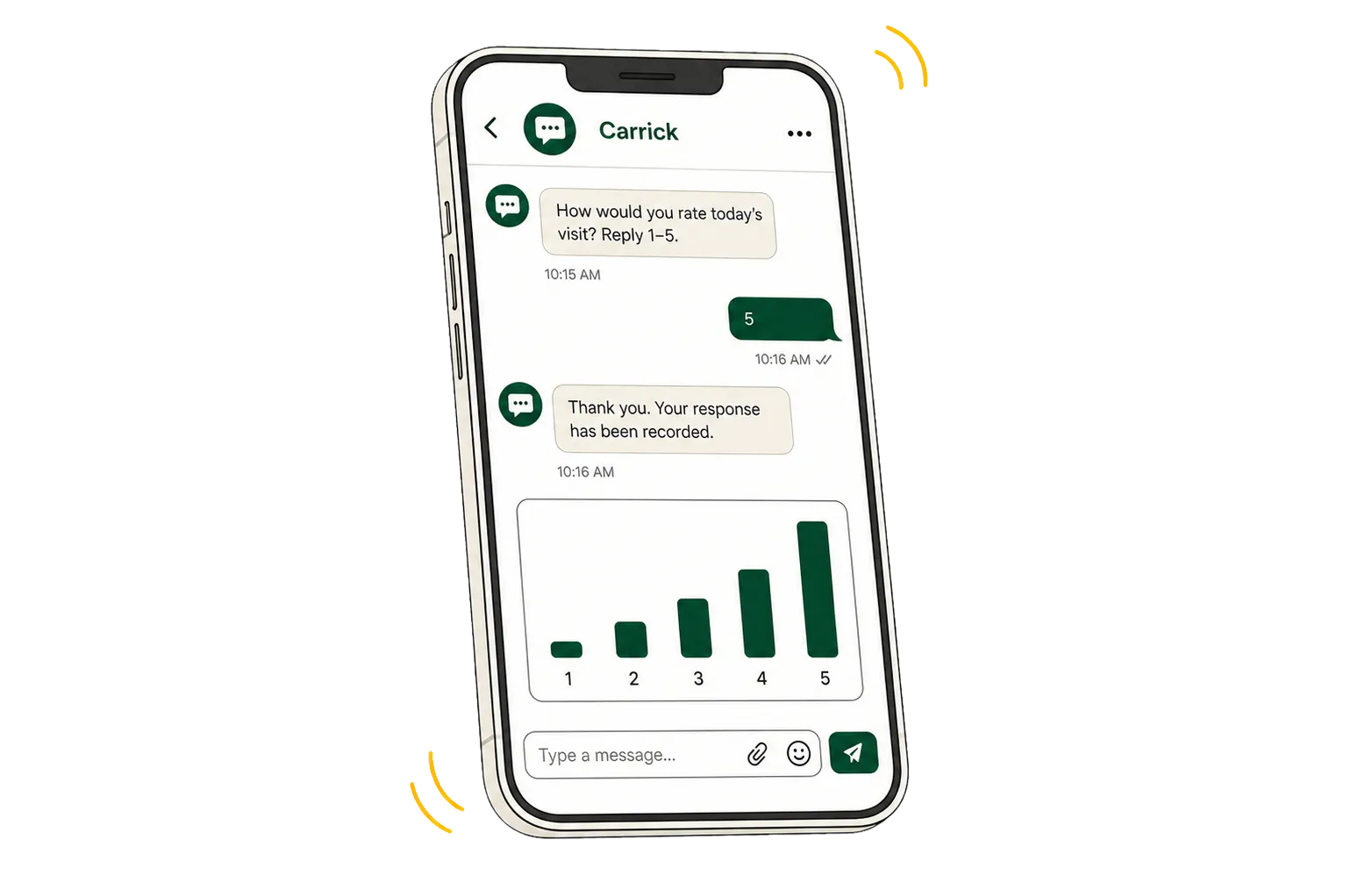
SMS polling, sometimes called text message polling, lets healthcare organizations ask focused questions and collect replies through ordinary text messages. An SMS poll is a question sent by text message that people answer by replying. A patient might text back a number from 1 to 5, choose between two options, or provide a short written response. There is no app to download and no portal to remember.
For healthcare organizations, that simplicity can make SMS polling useful for collecting timely feedback about access, communication, patient experience, and service design. But a short text poll is not the right tool for every research, quality-improvement, or clinical question. The value comes from knowing what to ask, how to protect privacy, and how to interpret the answers without overstating what the data shows.
This guide explains how SMS polling works in healthcare, how it differs from a longer survey, and what to consider before sending the first question. If you are already evaluating the technology, see Carrick’s SMS surveys and polling for healthcare.
What is SMS polling?
SMS polling is the process of sending one or more questions by text message and collecting the replies. Most polls use a simple response format:
- A rating, such as 1 to 5
- A yes-or-no answer
- A choice from a short numbered list
- A brief open-text response
The organization sends the question to an appropriate group of recipients. Each reply is recorded against the poll, and the results can then be reviewed as totals, percentages, trends, or individual comments, depending on the workflow.
In healthcare, an SMS poll could ask whether appointment instructions were clear, whether a proposed evening clinic would improve access, or how easy it was to book a visit. The goal is usually to collect one focused piece of information while the experience is still recent.
SMS poll, SMS survey, or online form?
These terms are often used interchangeably, but they describe different levels of effort for the patient.
An SMS poll is usually one focused question with a small set of possible answers. It works well when the organization needs a quick signal or a simple decision.
An SMS survey contains several questions delivered in sequence. The patient replies to one question and then receives the next. This can collect more detail, but every additional step increases the effort required to finish.
An online form sent by text uses SMS to deliver a link to a web questionnaire. It is better suited to longer questionnaires, conditional fields, detailed consent language, or information that should not be collected through ordinary text replies.
Choose the lightest format that can answer the question responsibly. A one-question poll should not be stretched into a clinical assessment, while a 20-question form should not be forced into a text conversation simply because SMS is available.
How does an SMS poll work?
A healthcare SMS polling workflow usually has six parts.
1. Define the decision
Start with what the team will do differently after receiving the answers. “We want more feedback” is not yet a decision. “We need to know whether patients would use appointments after 5 p.m.” is specific enough to shape a useful poll.
If no answer would change a service, workflow, or follow-up action, the poll may not need to be sent.
2. Choose the right recipients
The audience should match the question. A post-visit experience poll might go only to patients who completed an appointment. A question about new clinic hours might go to patients who have recently had difficulty finding an available time.
Avoid sending every poll to the full patient list. Relevance matters, and unnecessary messages can reduce trust in future communication.
3. Write the question and response options
The message should identify the organization, explain why it is asking, and make the reply format obvious.
For example:
Carrick Family Clinic: How easy was it to book your most recent appointment? Reply 1 for very difficult, 2 for difficult, 3 for neither, 4 for easy, or 5 for very easy.
Use plain language and keep the response options mutually exclusive. The CDC Clear Communication Index is a useful reference when reviewing public and patient-facing language.
4. Send at a relevant time
Timing should follow the experience being measured. A question about booking can be sent after an appointment is scheduled. A post-visit question is more useful while the visit is still recent. A public health team asking about clinic hours may need to leave the poll open for several days so people with different schedules can participate.
Avoid sending non-urgent polls at times when a message may feel intrusive. Also consider time zones, holidays, and how the timing could affect which groups are most likely to reply.
5. Collect replies and handle exceptions
Expected answers can be counted automatically. Unexpected replies need a defined path.
If a patient responds to a rating question with “I do not understand my instructions,” that message should not disappear into a chart. The workflow should flag it for an appropriate team member, acknowledge the patient, and make clear where urgent concerns should be directed.
An SMS poll is a feedback tool, not an emergency channel. The message and the follow-up process should never imply that an urgent clinical concern is being monitored through a survey response unless the organization has explicitly built and staffed that clinical workflow.
6. Review the results and act
Share the findings with the people who can make a change. Look at the distribution of answers, not just the average, and review open-text responses for recurring themes.
When possible, close the loop with patients. A short update such as “You asked for later appointments, so we are piloting one evening clinic each week” shows that participation led to a visible outcome.
Where can healthcare teams use text message polling?
The best use cases are focused, timely, and connected to an action.
Patient access
Ask about barriers to booking, preferred clinic hours, transportation, language access, or awareness of available services.
Example: “Which appointment time would be easiest for you? Reply 1 for weekday morning, 2 for weekday afternoon, or 3 for evening.”
Patient experience
Collect feedback about communication, courtesy, clarity, coordination, or ease of navigating a service.
Example: “After your visit, did you understand what would happen next? Reply YES or NO.”
If the answer is NO, the workflow should define whether the patient receives information, a call back, or another appropriate form of follow-up.
Patient experience is not exactly the same as patient satisfaction. Satisfaction can be influenced by expectations; experience questions ask about something that did or did not happen. “Did the team explain the next steps clearly?” is usually more actionable than “Were you satisfied?”
Program and service design
Clinics, hospitals, health systems, and public health teams can ask for input before changing hours, locations, education programs, or outreach plans.
Example: “Would a mobile vaccination clinic at the community center make it easier for you to attend? Reply YES, NO, or UNSURE.”
Follow-up on administrative communication
Polls can test whether directions, preparation instructions, or non-clinical reminders were understood.
Example: “Were the parking and arrival instructions for your appointment clear? Reply YES or NO.”
Staff feedback
Healthcare organizations can also use text polls for focused operational questions when SMS is an approved internal channel.
Example: “Which training time works best? Reply 1 for Tuesday at noon, 2 for Wednesday at 4 p.m., or 3 for Friday at 8 a.m.”
How to write an effective healthcare SMS poll
Ask one thing at a time
“Was your clinician respectful and were the instructions clear?” contains two questions. A patient may feel respected but still be unsure what to do next. Split double-barreled questions so each answer has one meaning.
Make every option clear
A 1-to-5 scale is ambiguous unless the endpoints are labeled. Say what 1 and 5 mean, and include options such as “not applicable” or “unsure” when they are legitimate answers.
Use neutral wording
Avoid questions that suggest the answer the organization wants.
Instead of:
How helpful was our convenient new booking system?
Use:
How easy or difficult was it to book your appointment?
Keep the effort proportionate
One question is often enough for a quick operational signal. If the team needs a reliable measure across several aspects of care, use a validated survey rather than inventing a long SMS sequence.
The Agency for Healthcare Research and Quality provides standardized CAHPS patient-experience surveys and guidance. Organizations that need formal comparisons, public reporting, or a validated quality measure should follow the relevant instrument and administration requirements instead of treating a convenience poll as equivalent.
Explain who is asking and why
Patients should not have to guess who sent the message. Name the organization and give a short reason for the question. Where appropriate, say how the answers will be used.
Provide another way to participate
SMS will not reach everyone equally. Some patients share phones, use landlines, have limited cellular service, need a different language, or prefer another communication channel.
For important measurement programs, consider phone, web, mail, interpreter-supported, or in-person options. AHRQ recommends tracking response rates and considering whether differences between responding groups could introduce bias.
Privacy, consent, and patient safety
Healthcare organizations should review privacy, security, consent, record-retention, and messaging requirements before launching a poll. The applicable rules depend on the jurisdiction, the purpose of the message, the information being collected, and the organization’s relationship with the recipient.
In the United States, an SMS workflow should be assessed under HIPAA rather than treated as automatically compliant because it uses a particular tool. HHS guidance on electronic patient communication emphasizes reasonable safeguards, limiting the information disclosed, applicable Security Rule requirements, and patients’ requests for confidential communication.
In Canada, organizations should assess the workflow under the privacy laws that apply to them, which may include PIPEDA, provincial health-information laws such as PHIPA, and rules governing electronic messages.
Before sending an SMS poll:
- Confirm that the organization has an appropriate basis to text each recipient.
- Make the sender and purpose clear.
- Provide and honor required opt-out choices.
- Avoid including sensitive details in the initial message unless the approved workflow protects them appropriately.
- Decide where responses will be stored, who can access them, and how long they will be retained.
- Plan how unexpected clinical or safety-related replies will reach a qualified person.
- Offer a safe alternative for patients who should not or cannot respond by SMS.
The organization’s privacy, security, compliance, and clinical leaders should review the final workflow. A software platform can support compliance controls, but it does not determine whether every message, audience, and use case is appropriate.
How should you measure an SMS poll?
Start with the response rate:
Response rate = number of valid respondents ÷ number of successfully delivered invitations
Define the numerator and denominator before comparing one poll with another. A result based on delivered messages is different from a result based on every number in the original list.
Also track:
- Delivery failures and outdated numbers
- Completed and partial responses
- Time to first response
- Opt-outs
- Results by relevant service, location, language, or time period
- The number of unexpected replies that required staff follow-up
Do not treat a high response rate as proof that the results represent the full patient population. People who reply may differ from those who do not. AHRQ notes that low or uneven response rates can create concerns about representativeness and recommends tracking response rates at both the individual and organizational-unit level.
For a simple operational poll, report what the responding group said and be clear about the limits. For research, regulated reporting, or comparisons between organizations, involve people with survey-methodology and statistical expertise.
Common mistakes to avoid
- Sending a poll without a decision or action attached to it
- Asking several ideas in one question
- Using unexplained rating scales
- Collecting sensitive information that belongs in a more secure workflow
- Assuming every patient can or wants to use SMS
- Treating a one-question convenience poll as a validated measure
- Reporting percentages without the number of respondents
- Ignoring unexpected free-text replies
- Sending repeated reminders without considering consent, burden, and opt-outs
- Collecting feedback but never sharing or acting on the result
Frequently asked questions about SMS polling
How many questions should an SMS survey include?
Use as few questions as the decision requires. One question is often enough for a poll. If the survey needs several items, tell patients how many questions to expect and consider whether an online form or validated survey would be clearer.
Are SMS poll responses anonymous?
Not necessarily. When a reply is matched to a phone number or patient record, the organization may be able to identify the respondent even if the report shows only grouped results. Do not describe a poll as anonymous unless the workflow has been designed and verified to prevent identification. “Confidential” and “anonymous” are not interchangeable.
Are SMS polls reliable?
They can provide a useful operational signal when the question, audience, timing, and analysis are well designed. They should not automatically be treated as representative research or as a substitute for a validated patient-experience or outcome measure.
Can SMS polling be used for clinical follow-up?
It can support an approved follow-up workflow, but a basic poll should not be used as an unmonitored channel for urgent symptoms, diagnosis, or emergency triage. Clinical questions need clear escalation rules, appropriate staffing, privacy safeguards, and patient instructions.
What should happen after the poll closes?
Review the results, document the limits, assign any follow-up work, and tell patients what changed when that is practical. Feedback is more valuable when it becomes part of a visible improvement cycle.
SMS polling works best when the question leads somewhere
The strength of SMS polling is not that it turns every questionnaire into a text message. It is that it gives healthcare teams a simple way to ask one relevant question at the right time and make the answer easier to act on.
Start with the decision, protect patient privacy, keep the question clear, and be honest about the limits of the results. When a longer or validated instrument is needed, use one. When a focused text reply is enough, SMS can create a direct connection between patient feedback and service improvement.
Want to see how this workflow can fit into connected patient communication? Explore Carrick’s SMS surveys and polling solution.
Sources and references
- The CDC Clear Communication Index — Centers for Disease Control and Prevention
- CAHPS Patient Experience Surveys and Guidance — Agency for Healthcare Research and Quality
- Methods for Increasing the Number of Responses to CAHPS Surveys — Agency for Healthcare Research and Quality
- What Is Patient Experience? — Agency for Healthcare Research and Quality
- Does the HIPAA Privacy Rule permit health care providers to use email to discuss health issues and treatment with their patients? — U.S. Department of Health and Human Services