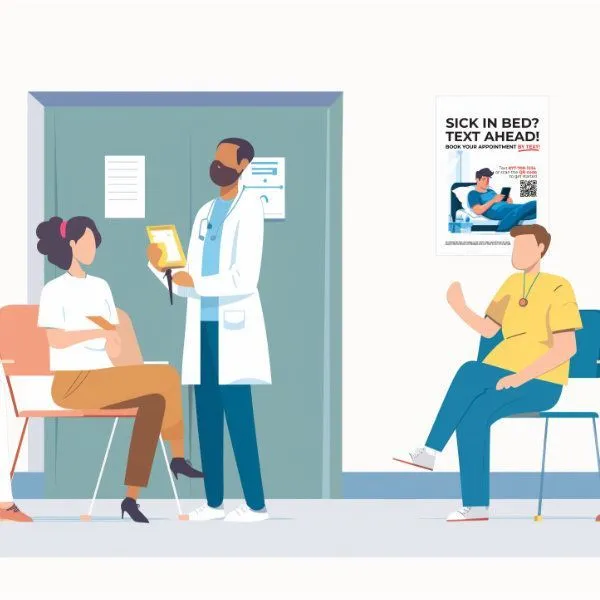
For many healthcare appointments, sending a text reminder 24–48 hours before the visit is a reasonable starting point.
But there is no single perfect time for every patient, appointment, or clinic.
A useful reminder needs to arrive early enough for the patient to act—and early enough for your team to respond. A routine visit may only need a reminder a day or two ahead. A procedure that requires preparation, transportation, or time away from work will need more notice.
In this article, we’ll look at:
- How far in advance to send appointment reminder texts
- When a sequence works better than one message
- How to time other patient communications
- What to measure so you can improve your approach
Is 24 or 48 hours better for an appointment reminder?
Either can work.
Research supports text reminders as a way to improve healthcare appointment attendance, but it has not found one timing interval that consistently works best across every setting.
That makes 24–48 hours a practical starting window, not a universal rule.
A reminder sent 48 hours ahead gives a patient more time to cancel or request a different appointment. It also gives staff a better chance of offering an available slot to someone else.
A reminder sent 24 hours ahead keeps the appointment visible when the patient is making plans for the next day. However, it gives the clinic less time to act if the patient can no longer attend.
The better choice depends on your appointment type, cancellation process, patient population, and how quickly staff can respond.
One perfectly timed message may not be enough
When appointments are booked weeks or months ahead, one message close to the visit may be asking too much of a single reminder.
A short sequence can give each message a clear job:
- Several days before: Give the patient time to change plans, arrange transportation, complete forms, or follow preparation instructions.
- 24–48 hours before: Confirm the date, time, and location, and provide a simple way to respond.
- The same day, when useful: Share practical arrival or check-in information close to the appointment.
This is an example, not a fixed formula. A quick follow-up appointment may not need three messages. A procedure with detailed preparation might need earlier communication.
More messages are not automatically better either. Repeating the same reminder too often can create noise and train patients to ignore future texts. Each message should help the patient do something useful.
Match the timing to the message
The “best time to send a text message” depends on what you need the patient to do next.
- Appointment reminders: Send early enough for the patient to confirm, cancel, or request rescheduling.
- Preparation instructions: Allow enough time to complete the preparation safely and correctly.
- Forms or intake requests: Give the patient time to complete them before the visit.
- Clinic closures or schedule changes: Send as soon as the information is confirmed.
- Recall or preventive outreach: Use reasonable local hours and provide a clear next step.
- Post-visit follow-up: Follow the care plan and clinical workflow rather than generic marketing rules.
This is where the old advice about avoiding Mondays or targeting a lunchtime “engagement window” falls short. Healthcare communication is not a retail promotion. The right time is when the message is relevant and the patient can act on it.
Choose a time when patients and staff can respond
Even a well-planned reminder can create frustration if it arrives when no one can help.
Before scheduling a message, ask:
- Is this a reasonable hour in the patient’s local time zone?
- Will someone be available if the patient replies?
- Is the patient being asked to complete something before the appointment?
- Does the message clearly explain what to do next?
- Are after-hours and urgent-message limitations clear?
If a reminder invites the patient to confirm, cancel, or ask a question, the team needs a plan for handling the response. That does not mean every inbox must be staffed around the clock. It means patients should understand when they can expect an answer and what to do if they need urgent help.
Weekends can also be appropriate when the timing is genuinely useful—for example, reminding someone about a Monday appointment. The day of the week matters less than relevance, local time, patient preferences, and whether your workflow can support the response.
Make appointment reminders two-way
A reminder is more valuable when the patient can act on it.
Instead of sending a one-way notification, give patients a clear option to confirm, cancel, or request rescheduling. Their response can reach the care team while there is still time to update the schedule.
This can reduce phone tag and help staff focus on the conversations that need personal attention. It can also turn an early cancellation into an opportunity to offer the appointment to another patient.
Carrick supports connected appointment reminder workflows that bring automated messages and patient responses into the same communication process.
The workflow should also account for unexpected replies. A patient may respond to a routine reminder with a clinical question. That message needs a different path than a simple “yes” or “no.”
What if text is not the right channel?
Texting will not reach everyone. A number may be outdated, a carrier may reject the message, or the patient may prefer another way to communicate.
Your reminder plan should define what happens next instead of assuming that one channel will always work.
Depending on the patient and workflow, the next step may be an automated voice reminder, a staff phone call, or another approved communication channel. Carrick connects text, phone, voicemail, and voice outreach so teams can build a more coordinated approach.
Voice should only be described as an automatic fallback after an SMS delivery failure if that exact workflow has been configured and tested. Otherwise, it is better described as an alternate channel within the reminder process.
Learn more about Carrick’s calling and voicemail capabilities.
Measure the action, not just the send time
There is no need to guess forever. Start with a sensible timing pattern, then review what actually happens.
Useful measures include:
- Confirmation and cancellation response rates
- How far ahead cancellations arrive
- No-show rates by appointment type
- Completed rescheduling requests
- Undelivered messages
- Opt-outs and preference changes
- Staff work created by patient replies
Look at these results by appointment type rather than treating every visit the same. A timing pattern that works for a routine office visit may not suit diagnostic imaging, a procedure, or a public health clinic.
The goal is not simply to send more reminders. It is to give patients enough time to respond, help staff act sooner, and make better use of available appointments.
Frequently asked questions
How far in advance should a clinic send an appointment reminder text?
For many appointments, 24–48 hours is a reasonable starting point. Send earlier when patients need time for preparation, transportation, forms, or schedule changes.
How many appointment reminders should a clinic send?
There is no universal number. Use the fewest messages needed to give patients useful notice and a clear next step. Appointments booked far ahead or requiring preparation may benefit from an earlier message followed by a final reminder.
Should clinics send reminder texts on weekends?
They can when the message is timely and appropriate, such as a reminder for a Monday appointment. Consider the patient’s local time, communication preferences, applicable requirements, and whether staff can handle replies.
What time is too early or too late to text a patient?
Avoid unnecessarily early or late messages. Use reasonable local hours, follow applicable messaging requirements, and consider whether the team is available if the message invites a reply.
What should happen when a reminder text is not delivered?
Follow the organization’s alternate workflow. That may include checking the patient’s contact information, using automated voice, calling the patient, or using another approved channel.
Give Patients Enough Time to Act
Good timing is not about finding one magic hour. It is about matching the message to the appointment, the action the patient needs to take, and the time your team needs to respond.
For many clinics, 24–48 hours before an appointment is a useful place to start. From there, test your timing, listen to patient preferences, and adjust the workflow for different types of care.
Carrick helps healthcare teams coordinate reminders, patient responses, voice outreach, and staff follow-up in one connected workflow. Talk to a Carrick expert.