Outbound AI voice calls for landline patients. When a patient cannot receive texts, Carrick's AI voice agent places an outbound call, delivers the appointment reminder or eligibility notification in spoken language, and listens for the patient's response. Confirmations, cancellations, and questions are captured and surfaced in the unified inbox alongside the patient's record.
Features · AI Voice Agent
AI Voice Agent for Healthcare That Reaches Every Patient — Including Those on Landlines
Most patient outreach runs on text. Most patients respond to text. But a portion of every patient population cannot receive texts — older patients, rural patients, patients on landlines. When those patients are also the ones most likely to miss screening appointments or drop out of navigation programs, leaving them unreachable is not an acceptable gap.
Carrick is the AI voice agent for healthcare outreach teams that need to reach every eligible patient — not just the ones who can receive a text. It handles outbound calls to patients on landlines, delivers appointment reminders and eligibility notifications in natural spoken language, captures patient responses, and converts missed calls into two-way text conversations — automatically. Every voice interaction lands in the same unified inbox as your SMS threads, giving your team one place to manage all patient contact across all channels.
80%
No-show reduction
50%
Fewer inbound calls
<4%
Current no-show rate
70,000+
Patients reached
30+
Active clinics
5×
Staff efficiency increase
What Is an AI Voice Agent for Healthcare?
An AI voice agent for healthcare is an automated system that conducts real-time spoken conversations with patients over the phone using natural language processing. Unlike a robocall or prerecorded message, an AI voice agent listens to patient responses, understands them, and replies in context — handling appointment confirmations, eligibility notifications, and follow-up questions without a staff member on the line.
Healthcare organizations use AI voice agents for two distinct purposes. The first is inbound call handling: replacing or supplementing front desk staff who answer patient calls about scheduling, prescriptions, and billing. The second is outbound patient outreach: proactively calling patients to deliver reminders, confirm appointments, notify eligible individuals of screening opportunities, and follow up on no-shows.
Carrick's AI voice agent addresses the second purpose. It is an outbound tool designed to reach patients who cannot be contacted by text — completing the outreach workflow for landline populations that two-way SMS cannot cover on its own.
Why Voice AI for Healthcare Programs Starts with the Patients You Cannot Text
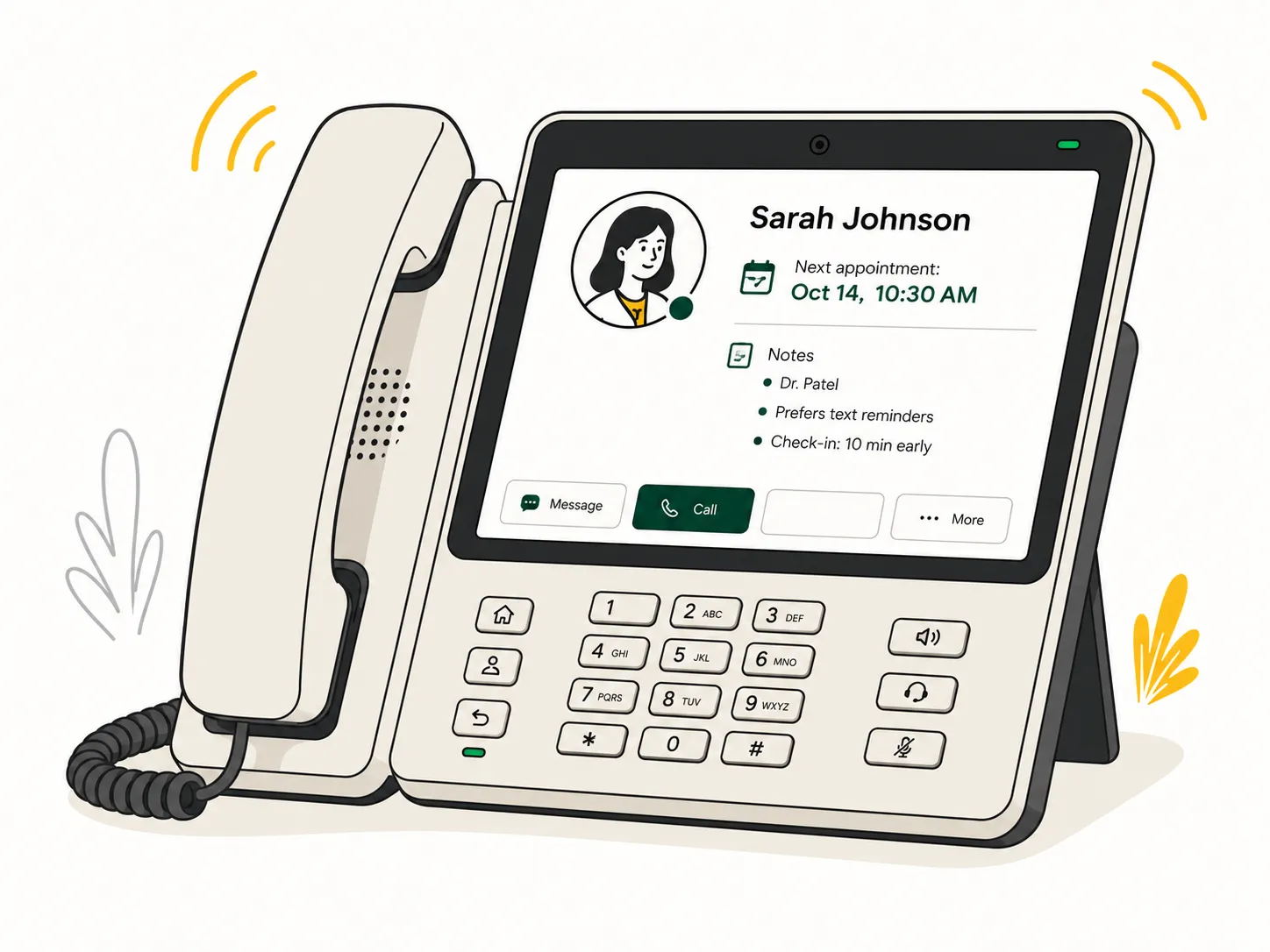
Voice AI for healthcare closes a gap that SMS cannot. Patient outreach programs that rely on text messaging reach most of their population efficiently — but a meaningful share of every patient list is on landlines. In provincial breast screening programs, rural health networks, and navigation programs serving older populations, these patients cannot receive appointment reminder texts, cannot reply to a broadcast message, and cannot be reached through the same channel as everyone else.
When those patients miss an appointment, the cost is high. A no-show in a screening program means a missed diagnostic window, not a rescheduled meeting. When navigators try to reach them by phone, every call requires staff time, often produces no answer, and leaves a voicemail that may never be returned.
The gap is not a technology problem in the abstract. It is a specific failure: a portion of the patient population that outreach programs know about, have contact information for, and cannot reliably reach through text. Voice AI for healthcare outreach programs closes that gap by handling outbound calls to landline patients automatically — delivering the same confirmation, the same reminder, and the same eligibility notification that SMS delivers to everyone else.
How AI Voice Agents for Healthcare Work in Carrick
AI voice agents for healthcare in Carrick are built into the same platform as two-way SMS, broadcast outreach, and the unified inbox. They are not a separate call center tool. They are the channel that runs alongside texting when texting cannot reach the patient.
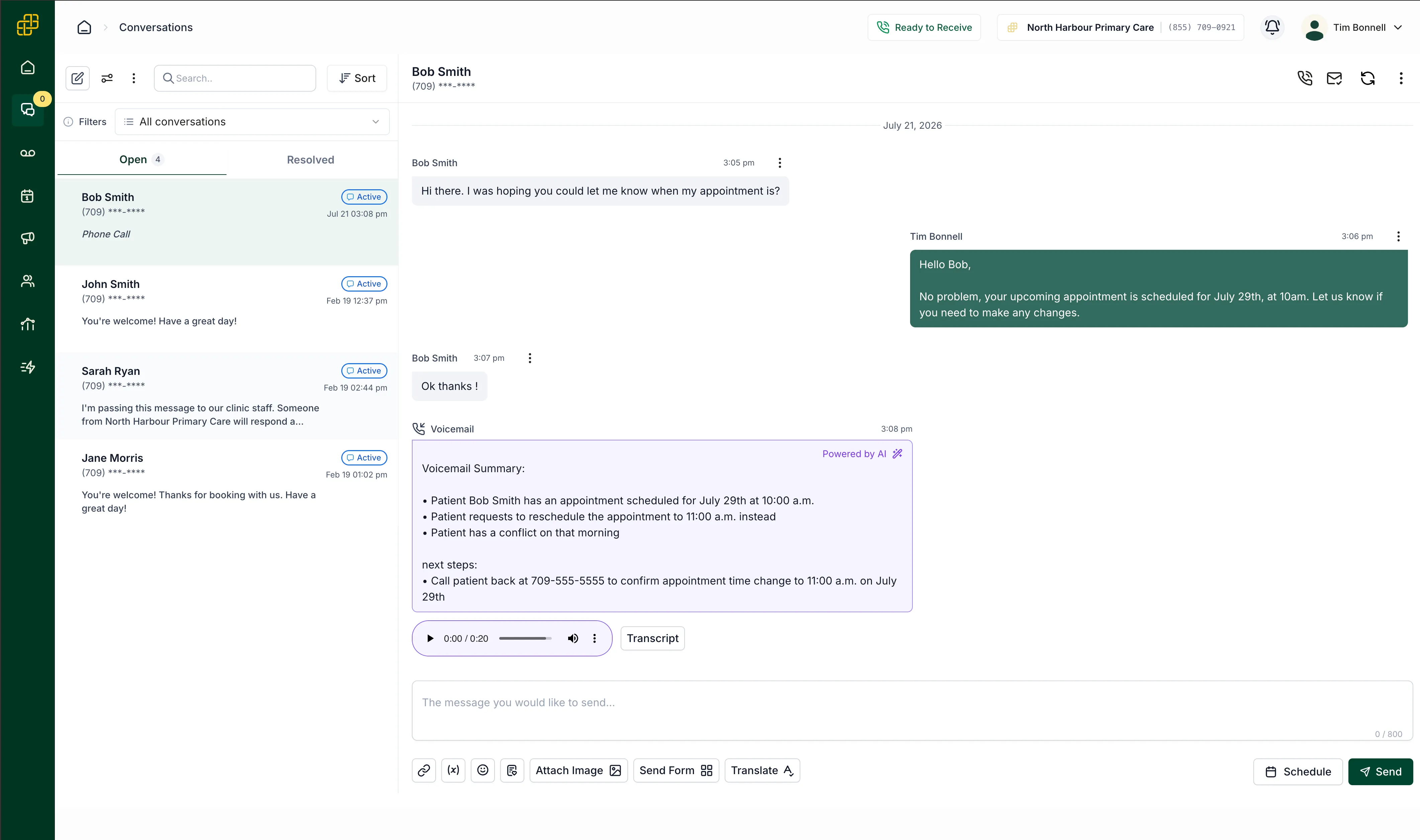
Voicemail transcription. When a patient does not answer, Carrick transcribes the voicemail and makes it available in the inbox as text. Staff review patient voicemails without listening to recordings — the same efficiency as reading a text reply.
Missed call to text conversion. When a patient calls the clinic and the line is unanswered, Carrick automatically opens a two-way text conversation. The patient receives a text they can reply to immediately. The missed call is flagged in the inbox alongside any open appointment threads.
Unified inbox across all channels. Every patient interaction — text, AI voice, voicemail transcription, missed call — is visible in one place, across the full team, on any device. Staff do not manage a separate call log. Everything flows into the same inbox.
AI Voice in Action — NL Health Services Breast Screening
NL Health Services manages a provincial breast screening program serving patients aged 40 to 74 across Newfoundland and Labrador — five locations, a dispersed rural population, and a 2025 eligibility expansion that added approximately 34,000 newly eligible individuals. A significant portion of that population is on landlines.
Before Carrick, the program ran outreach through phone. Staff called, patients did not answer, voicemails accumulated. After deploying Carrick across 30+ primary care clinics, the program reached 70,000+ patients, reduced no-shows by 80%, and brought the no-show rate below 4 percent. Inbound phone call volume dropped by 50 percent. Staff efficiency increased fivefold.
The AI voice feature was not the entire solution — it was the part of the solution that reached the patients two-way texting could not.

"It has significantly reduced the time staff spend calling patients and responding to voicemail. It allows the program to reallocate time to other clinical and administrative tasks. As well, patients are finding it much easier to contact the clinic, ask questions, and book or adjust their screening appointments."
Frequently Asked Questions
What is an AI voice agent for healthcare?
An AI voice agent for healthcare is an automated system that conducts real-time spoken conversations with patients using natural language processing and machine learning. Unlike prerecorded robocalls, an AI voice agent listens to patient responses and replies in context — handling appointment confirmations, outreach notifications, and follow-up questions without a staff member on the line. Healthcare organizations use them to extend outreach to patients who cannot be contacted by text, and to reduce the staff time required for phone-based patient communication.
What is the difference between Carrick's AI voice and a robocall?
A robocall plays a recorded message and cannot respond to what the patient says. Carrick's AI voice agent conducts a real conversation: it listens to the patient's spoken response — a confirmation, a question, a request to reschedule — and replies accordingly. The interaction is captured in the unified inbox as a structured record, not a call log entry that requires someone to listen to a recording.
Does Carrick's AI voice feature replace the clinic's phone system?
No. Carrick works alongside existing phone infrastructure. It does not replace inbound call handling or front desk workflows. It handles outbound patient outreach calls — delivering reminders and eligibility notifications to patients on landlines — and converts missed inbound calls into text conversations. The clinic's existing phone system stays in place.
Which patient populations benefit most from AI voice outreach?
AI voice outreach is most effective for patient populations with high landline rates — rural patients, older patients, and any population where a significant share of individuals cannot receive SMS. Navigation programs, provincial screening programs, and chronic disease management initiatives with geographically dispersed patient bases see the largest impact, because the patients they cannot reach by text are often the same patients most at risk of missing care.
See How Carrick Reaches Every Patient — Including the Ones on Landlines
Book a 30-minute call and we'll walk through your current outreach workflow, show you how Carrick handles AI voice alongside two-way SMS in a single inbox, and confirm compatibility with your scheduling system.