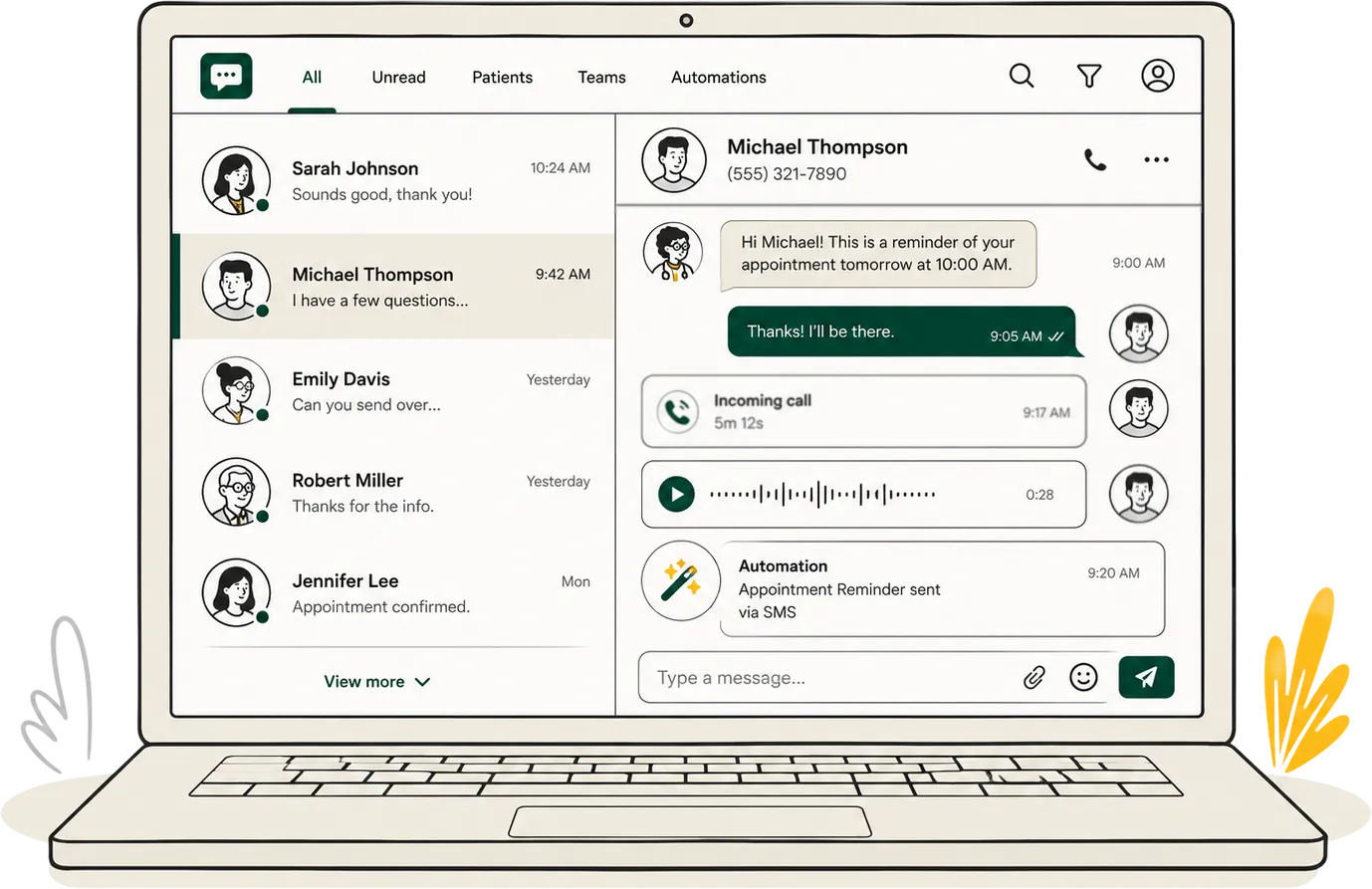
Two-way text messaging. Navigators send appointment reminders, eligibility outreach, and follow-up messages through native SMS — no app download, no patient account, no portal login required. Patients reply in the same thread. Staff see the reply alongside the patient's appointment record in the unified inbox.
Patient Navigation Software That Closes the Communication Gap
Patient navigation programs succeed when navigators can reach patients — and fail when they cannot. A navigator who knows a patient's pathway, eligibility window, and next appointment is still ineffective if the patient never confirms, never responds to voicemail, and misses the appointment that was booked on their behalf.
Carrick is the communication platform patient navigation teams use to replace phone-first outreach with two-way text, AI voice for landlines, and a unified inbox that captures every patient reply in one place. NL Health Services deployed Carrick across its provincial breast screening navigation program and reduced no-show rates by 80% — against a national average of 5 to 8 percent.
80%
No-show reduction
50%
Fewer inbound calls
<4%
Current no-show rate
70,000+
Patients reached
30+
Active clinics
5×
Staff efficiency increase
What Is Patient Navigation Software?
Patient navigation software is a category of tools that support patient navigators — the clinicians, nurses, and health workers responsible for guiding patients through complex care systems. Navigation programs are most common in oncology, breast screening, chronic disease management, and preventive care. Their job is to reduce gaps: patients who are eligible for care but have not accessed it, patients who have booked but do not show up, and patients who have started treatment but drop out before completion.
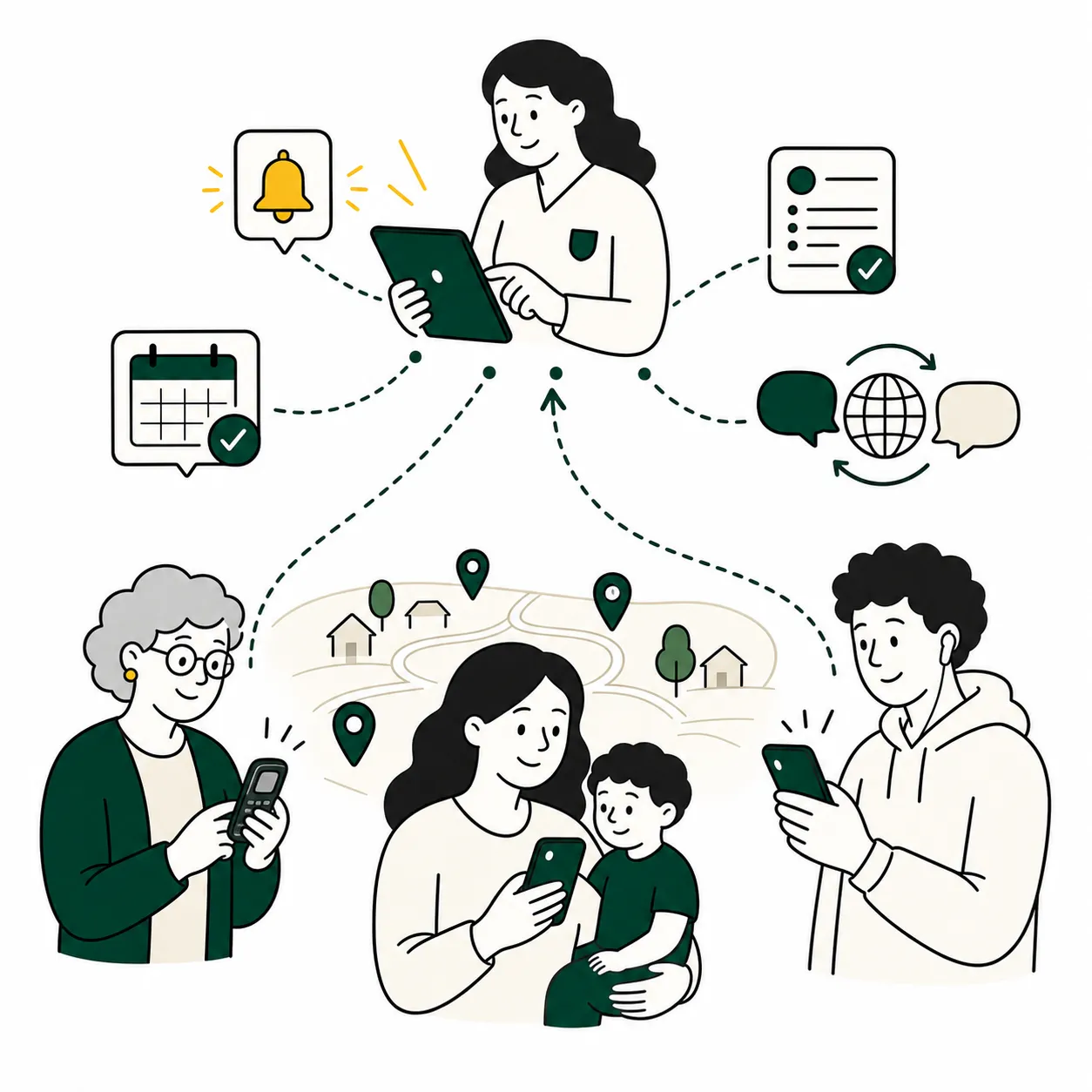
Navigation software typically covers two distinct functions. The first is care pathway management — tracking which patients are in which stage of a program, managing navigator worklists, and documenting clinical touchpoints. The second is patient communication — how navigators actually reach patients, confirm appointments, send reminders, and handle follow-up at scale.
Carrick addresses the second function. It is the communication layer: two-way text messaging, AI voice for patients on landlines, broadcast outreach to eligible patient populations, and a unified inbox where every patient reply is visible alongside the appointment record. For navigation programs that already use a pathway management system, Carrick is the outreach and contact channel those programs run on.
The Communication Gap in Patient Navigation Programs
Most patient navigation programs are built around phone outreach. Navigators call patients. Patients do not answer. Voicemails accumulate. Callbacks compete with clinical tasks. In a breast screening program serving patients across a geographically dispersed province — many of them rural, many on landlines, many unreachable during business hours — phone-first outreach is not a communication strategy. It is a capacity constraint.
The gap is not in pathway management. Navigation programs know which patients are eligible, which appointments are booked, and which patients are overdue for follow-up. The gap is in execution: reaching patients through a channel they actually respond to, at a scale that does not require a navigator to manually dial each one.
Text messaging fills that gap. A patient who does not answer a phone call will respond to a text. A navigator who cannot dedicate two hours a day to outbound calling can send and receive a hundred patient messages in the same time using a shared inbox. And a patient who misses a call can pick up the conversation through a text thread automatically opened by a missed call — without the navigator having to call again.
How Carrick Supports Patient Navigation Teams
Carrick's platform is built for the communication workflows patient navigation programs run every day.
Broadcast outreach to eligible populations. For screening programs conducting population-level outreach — reaching patients who are newly eligible, overdue, or have not yet scheduled — Carrick sends messages in bulk and receives replies individually. Each reply lands in the unified inbox where it can be handled without managing a separate campaign tool.
AI voice for landlines. For patients who cannot receive text messages — particularly common in rural populations — Carrick's AI voice agent handles outbound calls, delivers reminders, and captures patient responses without requiring a navigator to dial each patient manually.
Missed call to text conversion. When a patient calls and the line is busy or unanswered, Carrick automatically opens a two-way text conversation. The patient receives a text they can reply to immediately. The missed call is flagged in the unified inbox alongside the appointment thread.
Unified inbox. Every patient interaction — text, voice, missed call, broadcast reply — is visible in one place, across the full team, on any device.
Patient Navigation in Action — NL Health Services Breast Screening
NL Health Services manages a provincial breast screening program serving patients aged 40 to 74 across Newfoundland and Labrador — five locations, a dispersed rural population, and a 2025 eligibility expansion that added approximately 34,000 newly eligible individuals to the program's outreach target.
Before Carrick, outreach ran through phone. Staff called, patients did not answer, voicemails accumulated. No-show rates were above the national average. Inbound call volume competed with clinical tasks.
After deploying Carrick across 30+ primary care clinics, the breast screening program reached 70,000+ patients, reduced no-shows by 80%, and brought the no-show rate below 4 percent. Inbound phone call volume dropped by 50%. Staff efficiency increased fivefold.

"It has significantly reduced the time staff spend calling patients and responding to voicemail. It allows the program to reallocate time to other clinical and administrative tasks. As well, patients are finding it much easier to contact the clinic, ask questions, and book or adjust their screening appointments."
Frequently Asked Questions
What is patient navigation in healthcare?
Patient navigation is a structured program that connects patients — particularly those facing complex, chronic, or high-stakes care — with a dedicated individual who guides them through the healthcare system. Patient navigators help eligible individuals schedule appointments, overcome barriers to access, adhere to treatment plans, and complete follow-up care. Navigation programs are most common in oncology, breast and cervical cancer screening, chronic disease management, and preventive care outreach.
What is a patient navigator?
A patient navigator is a trained healthcare worker — often a nurse, social worker, or community health worker — whose role is to guide a specific patient population through the steps of a care program. Navigators identify eligible patients, initiate contact, book appointments, follow up on no-shows, and track patients who drop out of care. In provincial screening programs, navigators often manage large populations across geographically dispersed areas, making scalable communication tools essential to the role.
What software do patient navigators use?
Patient navigation programs typically use a combination of tools: a pathway or case management platform to track patient status and navigator worklists, and a communication platform to reach patients directly. Carrick handles the communication layer — two-way text messaging, AI voice for landlines, broadcast outreach, and missed call conversion — giving navigators a single inbox for all patient contact without replacing the pathway management system already in use.
How does Carrick reduce no-shows in patient navigation programs?
Carrick replaces phone-first outreach with two-way text, so patients receive appointment reminders through the channel they actually respond to. When patients confirm, cancel, or ask follow-up questions, staff see the reply in real time alongside the appointment record. For patients on landlines, Carrick's AI voice agent delivers outbound reminders and captures responses. Missed calls automatically convert to text conversations rather than unanswered voicemails. NL Health Services reduced breast screening no-show rates by 80% using this approach.
See How Carrick Fits Your Navigation Program
Book a 30-minute call and we'll walk through your current outreach workflow, show you how Carrick handles reminder volume and patient replies at scale, and confirm integration compatibility with your scheduling system.